How City Leaders Can Drive Innovation Without Having All the Answers
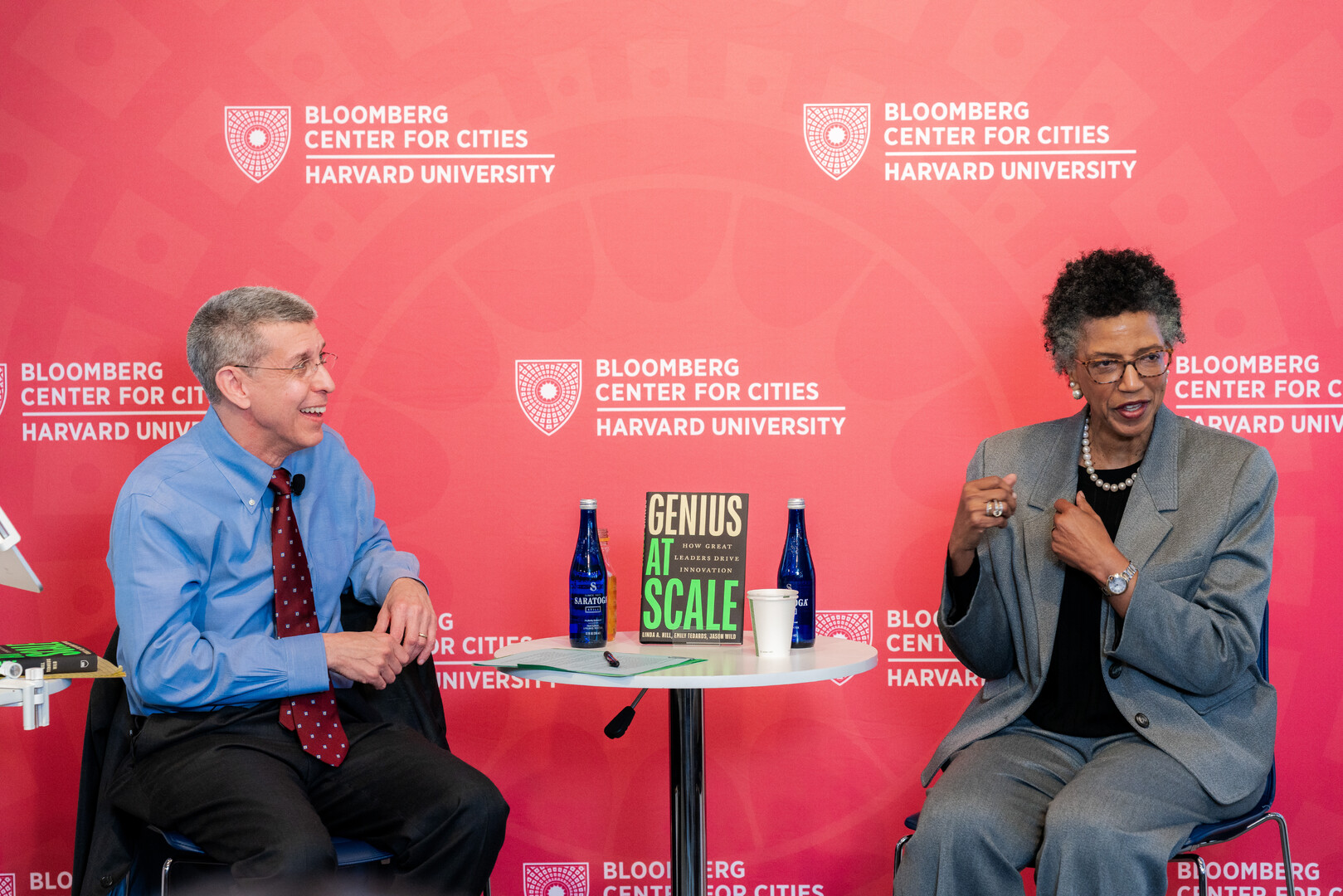
Cambridge, Mass. — City leaders are expected to solve complex problems, often without clear answers or a roadmap for getting there. What does it take to lead innovation under those conditions? According to Linda Hill, the Wallace Brett Donham Professor of Business Administration at Harvard Business School and a Bloomberg Center for Cities faculty affiliate, the answer isn’t necessarily having a bold vision, but creating the conditions for people to collaborate, experiment, and learn their way toward solutions.
At an October 29 event hosted by the Bloomberg Center for Cities, Hill discussed insights from her new book, “Genius at Scale: How Great Leaders Drive Innovation,” coauthored with Emily Tedards and Jason Wild. She was joined in conversation by fellow Center faculty affiliate Jan Rivkin, C. Roland Christensen Professor of Business Administration and Emma Bloomberg Professor at Harvard Business School.
Leading Innovation Without a Clear Destination
Rivkin opened the conversation by reflecting on how his understanding of innovation leadership had changed through Hill’s research. He once imagined an innovative leader as someone with a bold vision who inspired others to follow. Hill’s work challenged that assumption.
When Hill began studying innovative leaders in the late 1990s, she discovered that many rejected the idea that they needed to have a clear vision from the outset. They were pursuing innovation precisely because they did not yet know the answers. “Leading innovation is more about wayfinding than pathfinding,” Hill explained. “You are not sure of the destination, let alone the route. The task becomes how to create space for people to be willing and able to co-create the future with you, not to follow you to the future.”
Hill’s research identifies three roles leaders can play to make innovation possible: the architect, the bridger, and the catalyst. Together, these roles offer a framework for helping organizations and communities solve problems when the path forward is uncertain.
The Architect: Creating the Conditions for Innovation
The first role, architect, focuses on building an organizational environment where innovation can thrive. Hill describes innovation as a form of problem-solving that depends on three capabilities: collaboration, experimentation, and learning. Rather than directing every step, leaders must create the conditions for their teams to develop and test ideas together. “You cannot really plan your way all the way to an innovation,” Hill said. “You have to act your way there.”
For mayors, that means creating an environment where city employees feel empowered to solve problems, challenge assumptions, and test new approaches. “What I would say to a mayor or anyone wanting to do this work, is that your first task as an architect is to … create a context where people who work in the mayor’s office can do innovative problem-solving,” Hill said. An important part of that work is what Hill calls “creative abrasion”: encouraging constructive disagreement among people with different perspectives to generate ideas worth testing. Leaders must also recognize when an approach is no longer working and be willing to change course. Experimentation, however, can be particularly challenging in government, where failures often unfold under public scrutiny. Hill emphasized that the goal is not to celebrate failure but to create opportunities for learning. “You don’t value failure. You value learning,” she said.
The Bridger: Working Across Organizational Boundaries
The second role, the bridger, involves bringing together people, expertise, and resources beyond an organization’s formal boundaries. This capability is especially important in city government, where leaders must frequently work across departments and with businesses, nonprofit organizations, community groups, and other partners to address complex challenges.
“Every city government I know would say their ambitions to improve the city outstrip the resources of the city government itself,” Rivkin noted. For mayors and city leaders, bridging means developing relationships and partnerships that enable progress on shared priorities, even when they lack direct authority over the people or organizations involved.
Hill explained that successful collaboration depends on mutual trust, mutual influence, and mutual commitment to a shared goal. These relationships must be built before partners can effectively navigate questions of responsibility and decision-making. “You cannot use your formal authority to get people to innovate,” Hill said. “You can only invite people to innovate.” She argued that the ability to mobilize people across organizational boundaries is an essential form of leadership.
The Catalyst: Mobilizing Broader Networks for Change
While architects build the conditions for innovation within organizations, and bridgers connect people across boundaries, catalysts mobilize broader networks to create change across entire systems. Hill illustrated this role through the Sampark Foundation, established by Vineet and Anupama Nayar to improve primary education in rural India.
Despite committing $100 million of their own wealth, the founders discovered that funding alone could not produce sustainable improvements. Lasting change required strengthening relationships between government and teachers and mobilizing the people and institutions already working within the education system. “You are just trying to enable the assets that are already in the community,” Hill explained.
For city leaders, the catalyst role offers a way to think about challenges that extend beyond the capacity of any single department, organization, or sector. Addressing these problems requires building coalitions around shared goals and creating the conditions for those partnerships to sustain progress over time.
Leading Innovation Through Uncertainty
The conversation also explored how these leadership roles apply during periods of crisis, when public leaders face heightened uncertainty and pressure to act quickly. Hill described a hospital executive she studied during the COVID-19 pandemic who recognized that traditional top-down leadership would not be sufficient. Rather than attempting to direct every decision, he empowered staff to respond to changing circumstances and treated decisions as hypotheses to be tested through data and feedback. “He couldn’t steer the ship because he couldn’t see where to steer,” Hill said.
The example reinforced a central theme of Hill’s research: when leaders cannot predict what comes next, their effectiveness depends on building organizations that can learn and adapt. Hill also emphasized the importance of attending to employees’ well-being during periods of uncertainty. Leaders must recognize that people under sustained pressure may struggle to exercise good judgment and need support to perform effectively.
Throughout the conversation, Hill challenged the assumption that innovation belongs only to certain individuals or teams. When organizations separate those responsible for generating ideas from those expected to implement them, they can undermine their ability to bring innovations into practice. “When you set it up that way, nothing gets scaled,” she said. “We’re all innovators.”
For city leaders, Hill’s research offers an important lesson: driving innovation is not about having all the answers. It is about building organizations where people have the skills, support, and opportunities to collaborate, experiment, learn, and turn new ideas into better outcomes for residents.