
Threats Against Women in Local Office: What Research Reveals and How Cities Can Respond
New research reveals how threats and harassment are affecting women in local office and shaping political participation.
Cambridge, Mass. — Threats and harassment against women in local office are making public service difficult. They are also influencing who stays in office, who pursues leadership opportunities, and ultimately, who gets represented in local government.
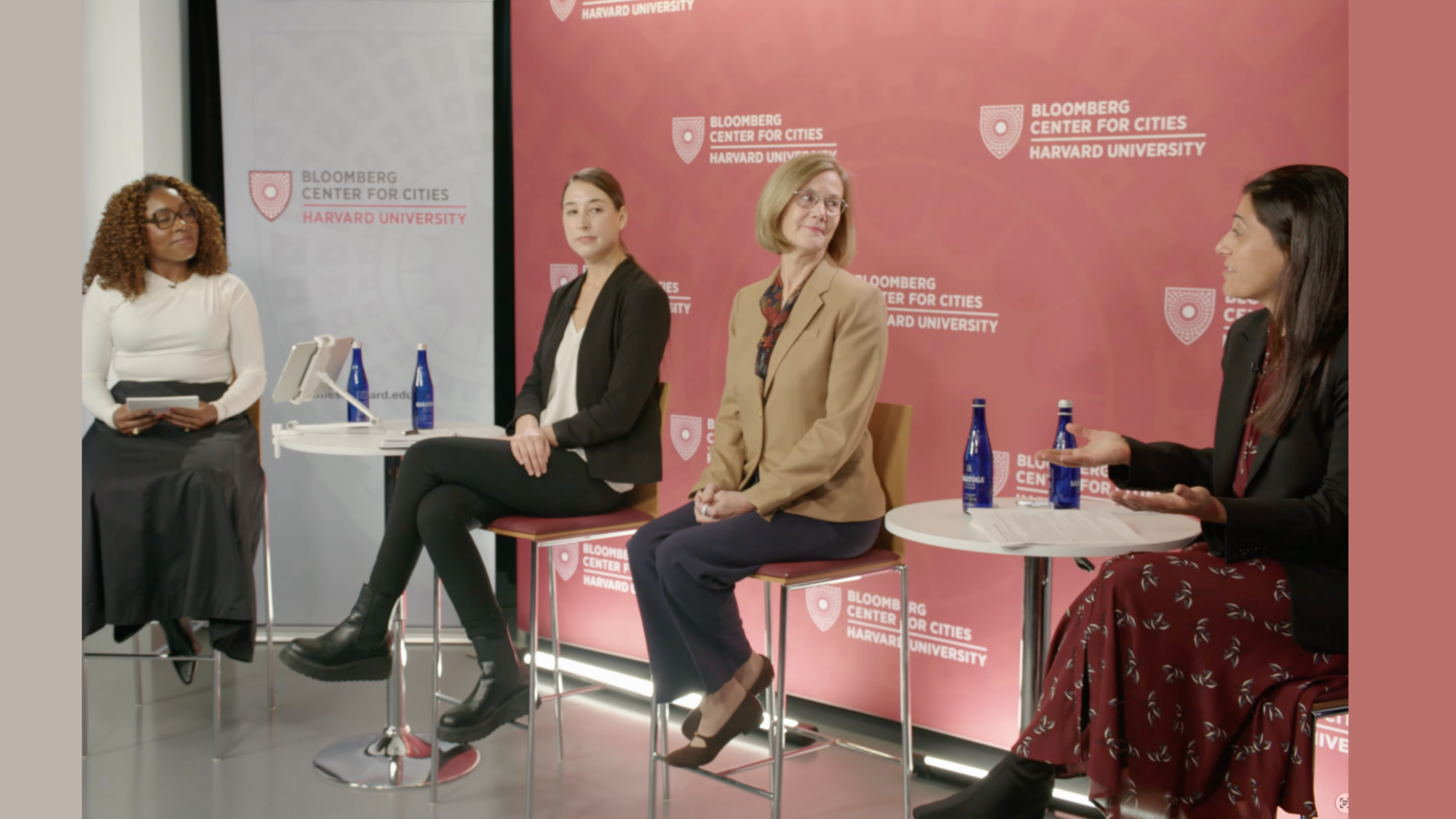
At a November 13 event hosted by the Bloomberg Center for Cities at Harvard University, new research and firsthand experiences from city leadership highlighted the consequences of political violence against women and the steps cities can take to respond.
The conversation brought together Rochester, Minnesota, Mayor Kim Norton; Nazita Lajevardi, associate professor of political science at the University of Michigan; and Katie Wells, program manager for the North America Regional Hub at the Strong Cities Network. Moderated by Jessicah Pierre, senior director of communications and engagement at the Center, the discussion explored how cities can strengthen institutional protections, support elected officials, and preserve opportunities for women to lead.
What the Research Reveals
In 2024, the Bloomberg Harvard City Leadership Initiative, a program of the Bloomberg Center for Cities, provided funding for four research projects examining violence against women mayors. This support aimed to address critical gaps in research on the conditions under which women lead in local government and generate evidence that can inform efforts to better protect elected officials and strengthen local democracy.
At the event, Lajevardi shared findings from one of these projects, revealing how experiences of political violence differ across gender and race and how those experiences can influence political participation and leadership decisions.
Political violence is defined broadly, encompassing harassment, threats, malicious impersonation, physical attacks, and property damage. Among the local officials surveyed, 46% reported experiencing at least one of these forms of violence in the past year.
The burden was not evenly shared. While approximately 1% of white male officials surveyed reported physical violence, that figure rose to about 7% among women of color. Women of color were also more likely than any other group to experience every form of political violence measured in the study. While hostile comments about political parties and policy positions affected officials across demographic groups, women of color also experienced harassment targeting their race and gender.
The consequences extend beyond individual experiences. Lajevardi’s findings indicate that women of color are less likely to seek reelection, while white women are less likely to pursue higher office, engage with controversial issues, or communicate publicly about their work.
Given that local government often serves as an entry point into political leadership, these effects have implications for the future of political representation.
“Together they add up to immense consequences for democracy,” she said. “Every time someone is harassed, threatened, or impeded in such a way through these means, there are consequences not just for that person but for the pipeline behind them … there’s a cumulative impact here.”
The Personal Cost of Public Service
For Mayor Norton, the first woman to serve as mayor of Rochester, Minnesota, the findings reflect challenges she has experienced firsthand.
Norton described how harassment intensified during the COVID-19 pandemic, with online hostility escalating into threats that extended beyond digital spaces, including the publication of her home address.
“The types of threats are not the types of threats the male mayors are getting,” she said.
The experience changed how she approached a central part of her job: being accessible to the community.
Having built her career on engaging directly with residents, Norton began asking her husband or friends to accompany her to public events rather than attending alone.
Even requesting additional protection presented challenges. When she sought a police presence at events, she worried about being perceived as misusing public resources.
“Then I’m viewed as wasting taxpayer dollars,” she said.
Rochester also disabled comments on its official Facebook pages after managing hostile exchanges became an increasingly significant demand on staff time.
“That’s not what city officials should be doing, is monitoring social media all day,” Norton said.
Her experiences illustrated a central concern raised throughout the discussion: when elected officials must manage threats and harassment largely on their own, the consequences can affect both their personal safety and their ability to serve the public.
Making Safety an Institutional Responsibility
Katie Wells of the Strong Cities Network, which works with more than 300 cities across 70 countries, emphasized the importance of shifting responsibility for preventing and responding to threats from individual officials to the institutions in which they serve.
“Most often, the burden of prevention and response falls on the individual themselves,” she said.
Wells outlined measures local governments can take to strengthen their responses, including training staff to assess risks, establishing systems to document and report incidents, creating clear escalation procedures, and dedicating resources to address threats, particularly those originating online.
She also emphasized the importance of workplace cultures in which concerns about harassment and intimidation are taken seriously rather than dismissed as an unavoidable part of public service.
The panelists pointed to approaches already being adopted by local governments. Some cities have strengthened conduct rules for public meetings or introduced additional security measures. Others have explored funding or reimbursing home security assessments for elected officials, including Pasadena, California, and several Canadian municipalities.
Some states have also adopted measures allowing public officials to remove their home addresses from publicly accessible records, although these protections do not always extend to local elected officials.
Norton urged law enforcement agencies and the legal system to take threats against elected officials seriously. Lajevardi noted that some states have begun pursuing more aggressive prosecution of threats and called for greater investment in interventions.
Together, these approaches reflect an important shift: treating the safety of elected officials as an institutional responsibility rather than an individual burden.
Keeping Public Comment Open
Asked how a city tightens meeting rules without shutting out residents, the panel rejected the premise that the two conflict. Public comment is how residents hold officials accountable, Lajevardi said; the answer is to establish rules with consequences not to limit civic engagement.
In Rochester, Mayor Norton’s team shortened comment periods but added town halls and a community co-design process, in which leaders of marginalized communities work with residents outside of formal meetings and bring their concerns back to the city to ensure more diverse perspectives are heard.
Protecting Officials While Preserving Public Participation
The discussion also explored how cities can protect elected officials without limiting opportunities for residents to participate in local democracy.
Asked how governments can strengthen public meeting rules while preserving public comment, the panelists emphasized that safety and civic participation should not be treated as competing priorities.
Lajevardi underscored the importance of public comment as a mechanism for residents to hold elected officials accountable. Establishing clear expectations for conduct, along with consequences for violations, can help maintain opportunities for meaningful engagement while addressing harassment and intimidation.
The approach reflects an effort to make civic participation more accessible and representative while maintaining appropriate boundaries for public engagement.
Strengthening Support for Women Leaders
Beyond formal protections, the panelists emphasized the importance of peer networks and institutional cultures that support women in public office.
Wells noted that harassment can originate both outside and within government institutions. Internal reporting procedures are often less developed than those addressing external threats, and colleagues who witness inappropriate behavior may be reluctant to intervene.
Women local leaders consistently tell the Strong Cities Network that harassment “has to be acknowledged, and it has to be condemned in the moment,” Wells said.
Norton credited networks of women mayors with providing important support during difficult experiences. Having peers who understand the challenges of public office can help elected officials navigate threats and harassment, although she cautioned that peer support should not substitute for institutional action.
“It’s still not right,” she said, “but you have that person to talk to.”
Organizations including the Mayors Innovation Project, the African American Mayors Association, and the Strong Cities Network are helping build these connections and provide resources to support local leaders.
For Lajevardi, an important next step is understanding not only how political violence affects women already serving in office, but also how it may discourage potential candidates from entering public life.
“We need to study the people who never run for office,” she said. “Understanding how we lost a supply of candidates is so important for future research.”
The discussion underscored that addressing threats and harassment against women in local office requires more than helping individual leaders navigate difficult experiences. It calls for stronger institutional protections, meaningful accountability, and continued research into the barriers that shape political participation.
As cities consider how to respond, the stakes extend beyond the safety of today’s elected officials to the future of local democracy and the next generation of women leaders.