
Cities After Dark: How Night Mayors Are Rewriting Urban Governance
Cambridge, Massachusetts (December 2, 2025)— A park bench is an unremarkable part of the urban fabric during the day. But as urbanist Andreina Seijas reminded an in-person and online audience at the Bloomberg Center for Cities, that same bench at midnight serves different users than it does at noon—and reveals needs that cities are addressing.
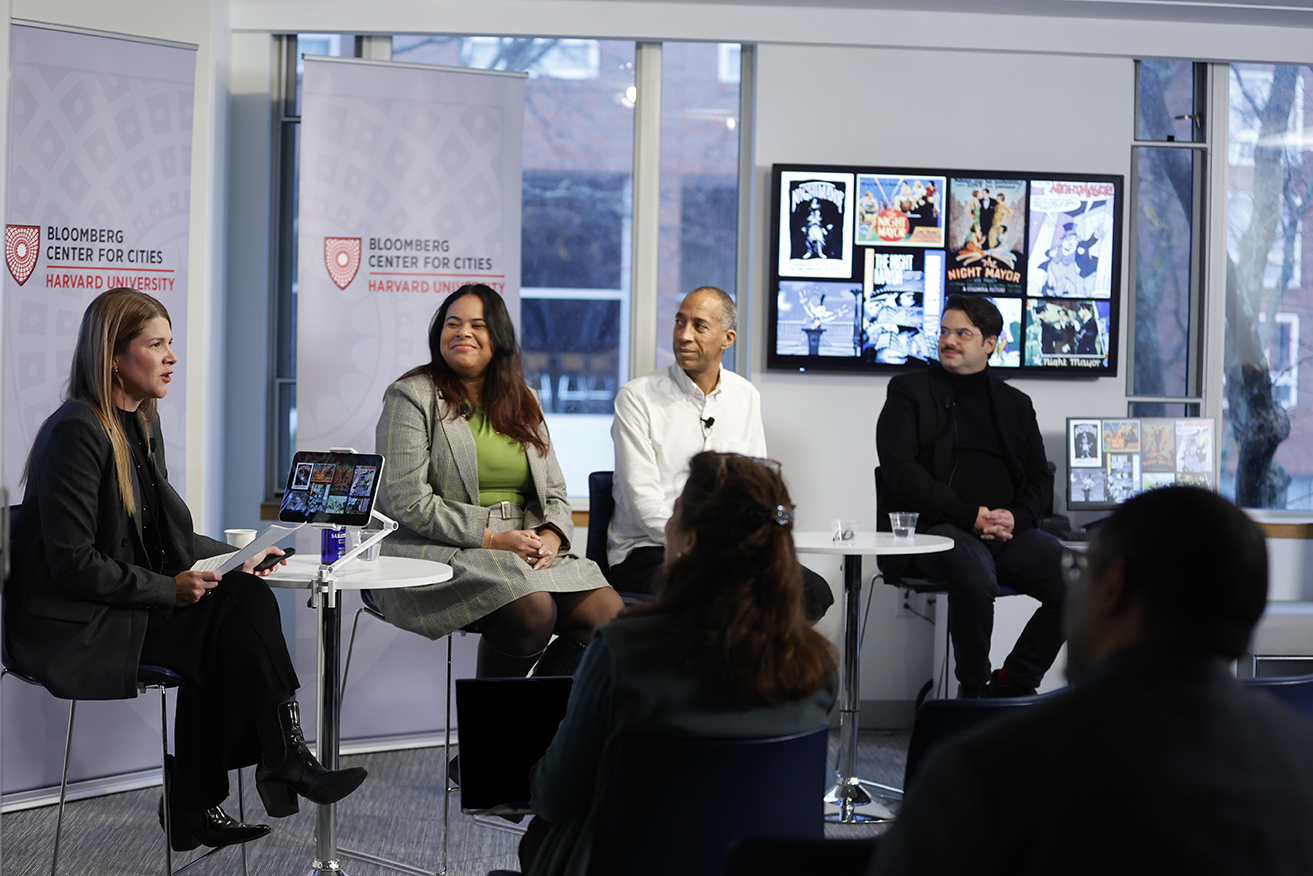
At Cities After Dark: 24-Hour Governance and the Role of Night Mayors, Boston’s Director of Nightlife Economy, Corean Reynolds, and Ottawa’s Nightlife Commissioner, Mathieu Grondin, picked up that thread, showing how night-shift nurses, delivery workers, bar staff, young people, and unhoused residents rarely appear in policy debates focused on daytime economies and infrastructure. Moderated by Seijas, Founder and Principal of NightTank, with scholarly framing from Garnette Cadogan, Tunney Lee Distinguished Lecturer at MIT, the panel examined what it means to govern cities across the entire 24-hour cycle. “I call myself a little bit of a nightlife therapist,” Reynolds said, “because [night workers] didn’t have that direct line to City Hall.”
Nighttime governance and economic development
Reynolds emphasized that Boston’s nighttime strategy reaches far beyond bars and clubs. Her charge includes hospital staff leaving late shifts, food access after hours, neighborhood-level activation, and the needs of workers who keep the city functioning while most residents sleep. For a city competing to retain students and attract employers, she said, the night is part of the value proposition. Residents consider not only where they can work, but where they can live, seeking spaces to gather, decompress, connect, and pursue wellness after the workday ends.
In Ottawa, Grondin is focused on developing a healthier and more accessible nighttime ecosystem. With affordability shaping how people socialize, he described the importance of animating public spaces, recognizing nontraditional venues as cultural infrastructure, and ensuring that people who work or travel at night inhabit a city that supports them with appropriate planning, regulations, and innovation as it does for daytime residents.
Translators inside City Hall
Neither practitioner holds executive authority; instead, their work depends on cross-department collaboration, relationship-building, and cultural change inside and outside of city hall. Reynolds described the central task of bringing the lived experience of night-shift nurses, barbacks, and delivery drivers into policy conversations that have historically excluded them. “Developing what I call the nightlife reflex inside City Hall,” Grondin said, “is part of the role, because people at City Hall… are daytime people.”
A field shaped by equity and lived experience
Seijas anchored the discussion in time-based urbanism: treating time, like space, as a core variable in planning and asking who is visible and who is missing across the 24-hour cycle. She pointed to emerging strategies, maps, and citizen-generated data that foreground the experiences of night-shift workers, women, young people, communities adapting to extreme heat, and other groups of residents.
Cadogan underscored how nighttime experiences reveal longstanding questions of lighting, safety, rest, and public space that disproportionately affect marginalized communities. For him, the study of the night is inseparable from understanding the city as a whole, “in all its richness and its multitudinousness.”
Solving problems in cities at night
Audience questions highlighted the challenges “night mayors” face, including public safety, a lack of youth spaces, mental health needs, public incivilities, and transit trade-offs. Participating online, Mayor Barbara Buffaloe of Columbia, Missouri, asked the first question, seeking the panel’s views on managing people experiencing homelessness in open spaces at night. Noting that homelessness was truly the “day mayor’s” job, Reynolds said her vantage at least allowed her to recognize things as they happen and start to ask questions that could lead to innovation, partnerships, or incentives to advance understanding and improvements in conditions for city residents. The discussion revealed that nighttime governance is not a niche concern, but can illuminate issues that exist through all 24 hours of the day. Solving problems in cities at night can aid broader goals of equity, economic competitiveness, and community wellbeing.
Reynolds and Grondin, with a growing global network of counterparts, are helping cities recognize that planning for night-shift workers, late-night travelers, and those who rely on public space after dark also strengthens the daytime city. For current leaders and future policymakers, the panel’s insights delivered broad opportunities for discussion, thought, and innovation.
Cities After Dark: 24-Hour Governance and the Role of Night Mayors
Watch the recorded discussion.