
From Legal Training to Local Government: Two Bloomberg Harvard Summer Fellows Tackle Child Poverty and Behavioral Health
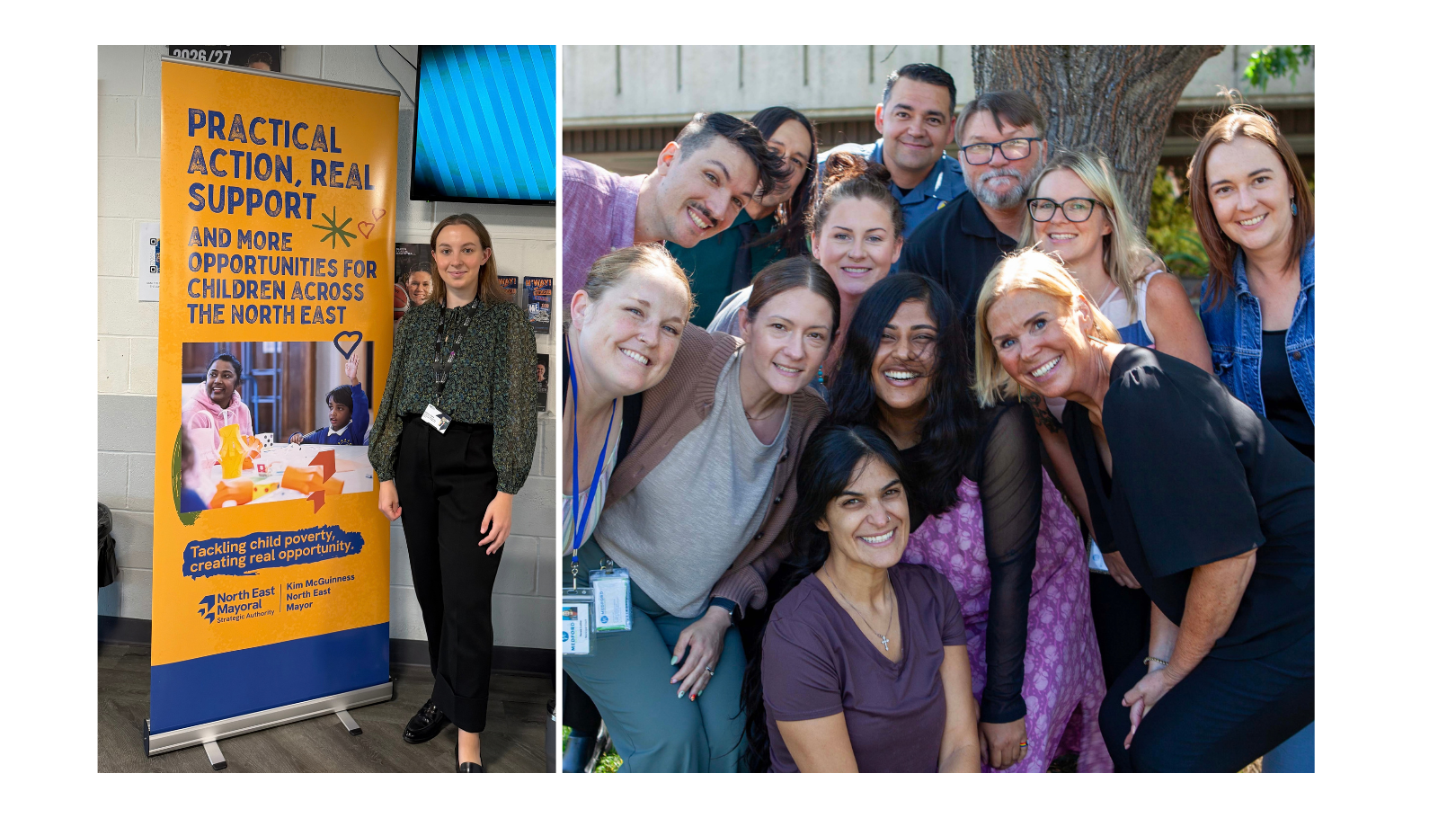
The Summer Fellows spent 10 weeks applying their legal training to child poverty in North East, England and behavioral health challenges in Medford, Oregon—discovering new ways to make an impact through local government.
September 22, 2026, Cambridge, Massachusetts—Rebecca Collins and Shreyashi Ray came to Harvard with experience in law. This summer, they stepped into local government to work on problems the legal system alone can’t solve.
Collins, a Master in Public Policy student at Harvard Kennedy School, worked with the North East Mayoral Strategic Authority in England to develop a Social Value policy designed to help reduce child poverty. Ray, a Master in Public Health student at the Harvard T.H. Chan School of Public Health, worked in Medford, Oregon, to assess the feasibility of a mental health court and develop tools to support its potential implementation.
Both received Summer Fellowships from the Bloomberg Harvard City Leadership Initiative, joining a cohort of Harvard graduate students placed in U.S. and international cities to advance priority projects and gain direct experience with the possibilities for leadership and immediate impact in local government.
For Collins and Ray, the experience offered a new perspective on public problem-solving: one that brought them closer to implementation, required collaboration across systems and sectors, and showed how their legal training could be applied in service of significant improvements in the life paths of city residents.
Using public spending to tackle child poverty in North East England
Collins was drawn to the North East in part because of the region’s ambitious work to reduce child poverty. “Regions are much closer to the people and better suited to serve residents’ needs,” Collins said. “What the North East is doing in terms of child poverty is quite revolutionary, so when I saw that the region was an option for the fellowship, I was keen to participate.”
The North East Mayoral Strategic Authority is required to have a Social Value policy—a framework for using public procurement to generate as much public benefit as possible. Local leadership had adopted the national framework but had not yet tailored it to the region’s priorities. Collins’ assignment was to help develop the Social Value policy along with a framework for evaluating and monitoring its implementation.
Decreasing child poverty is a major priority for the region. About 120,000 babies, children, and young people—roughly one in three—live in poverty in the North East. The region, under Mayor Kim McGuinness, has responded with a Child Poverty Action Plan backed by £28.6 million in investment. The action plan includes projects which support families with childcare costs, provide Baby Boxes for new families (physical boxes with essentials for baby care that focus on infant development and parental well-being), and ensure children and young people access to low and no cost opportunities outside of school.
Embedding Social Value into public spending will help the North East use investments in services and infrastructure to generate better jobs, skills, and opportunities for residents, helping families maximize their incomes to better support their children.
Collins’ legal background proved directly useful. As a litigation lawyer in London, she had spent years interpreting existing laws. In the North East, she found herself in a different part of the process—helping government determine what commitments it should ask of businesses.
She began by researching practices elsewhere in England, then held co-design sessions with more than 70 national and regional organizations, including nonprofits, small and medium-sized businesses, and youth groups.
“The youth groups and some of the other organizations were very surprised that we asked for their input,” Collins said. “Many of the people I interviewed had never been asked to weigh in on policy before, but it was important that it reflected local interests and needs.”
Her fellowship coincided with a significant shift in the national conversation about devolution. Prime Minister Andy Burnham, formerly mayor of Greater Manchester and an alumnus of the Bloomberg Harvard City Leadership Initiative’s flagship program for mayors, has made transferring greater power and resources to local and regional government a priority of his new government.
“I was lucky to be there during this particularly important political moment,” Collins said. “More money is being afforded to mayors than ever before, which gives greater opportunities for areas like the North East, which is already a pioneer for child poverty reduction in England.”
One of the North East’s next goals (and by 2030) is to work with local authority partners, childcare settings, and employment support providers to expand Mayor McGuinness’s childcare grant to more parents and carers across the region, to support them to more easily access paid employment and training opportunities.
Collins hopes that the way in which she helped develop the Social Value policy—with co-designed sessions and bringing in local partners—can be a model for future initiatives like these.
Rethinking what happens when the legal system meets a mental health crisis
Ray’s fellowship took her to Medford, Oregon, where she helped the city explore whether—and how—to establish a mental health court for people whose behavioral health needs contributed to their involvement in the criminal justice system.
Her experience quickly demonstrated how interconnected city challenges can be. Ray saw how transportation, housing instability, behavioral health, and interactions with the justice system could compound an individual’s situation.
“There were people who had suspended licenses or didn’t have a functioning car, which would lead to compliance issues with their court dates,” Ray said.
Medford had already established an outreach court that considers the circumstances facing people experiencing homelessness and connects defendants with additional support. Ray’s assignment was to examine how a mental health court could build on that approach while balancing accountability and public safety.
Drawing on more than three years of experience in drafting legislation for health, disability, and queer rights, she researched mental and behavioral health courts across Oregon and other states, examining their structures, resource needs, outcomes, and implementation challenges. She paired that with consultations to identify practices that could work in Medford and strategies for building internal and external support.
“I’ve been on both the higher-level policy infrastructure side and the implementation side,” Ray said. “I am interested in understanding how those intersect with each other, especially in local government, where one office is often responsible for many things. You can be involved in the implementation at a more granular level.”
Ray translated her findings into a feasibility assessment, research database, and implementation tools designed to help the city consider not only how to establish a mental health court, but how to evaluate its performance and sustain it over time.
Her approach drew on her studies at the Harvard T.H. Chan School of Public Health, particularly its emphasis on understanding public problems as interconnected systems rather than isolated issues.
“Officials sometimes think of improving the city for its residents and dealing with people involved in the criminal justice system as two separate issues, when in my view, they’re two sides of the same coin,” she said.
Seeing local government as a place to make an impact
For both fellows, the summer offered more than an opportunity to complete a project. It provided a window into how local governments solve problems—and how their own specialized skills could be put to use.
“Although local government often has more limited resources, it’s where a lot of service delivery and action is done,” Collins said. “Goodwill, passion, and commitment go far and if you put in the effort, you can see real change.”
Ray said the fellowship’s structure helped her navigate an unfamiliar system while giving her a broader view of what a career in local government could offer.
“This fellowship is a great place to start if you’re looking for a government role,” Ray said. “City hall is a microcosm of the whole city—it encourages you to contextualize policy and interact with both the community and other service providers. In city hall, you can’t afford to work in a silo. It’s the best place to see your impact in action.”