
Watch the full conversation
— video of the September 16 event, including the audience question period.
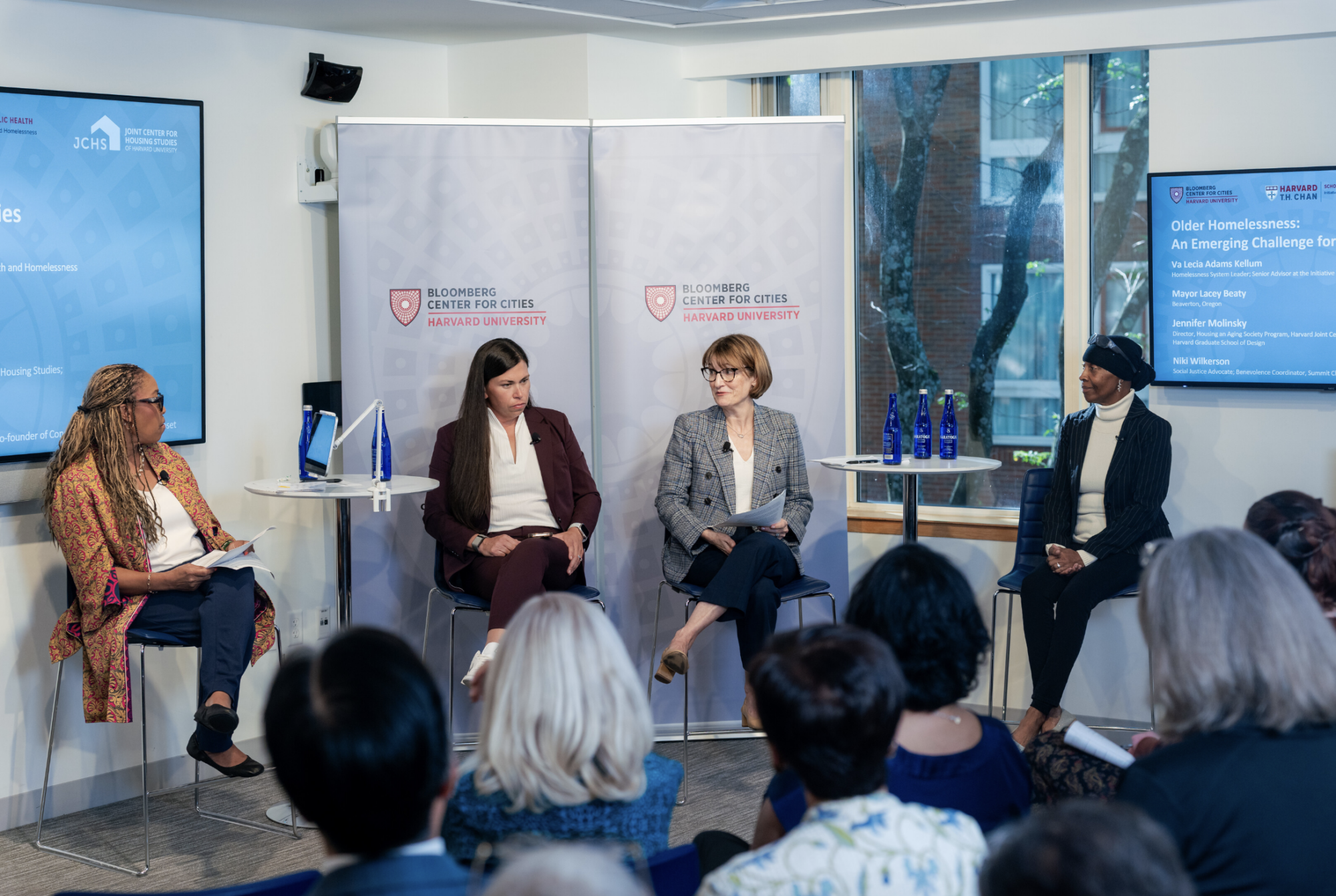
At an event at the Bloomberg Center for Cities, a panel examined why older adults are the fastest-growing group experiencing homelessness—and how cities can respond.
CAMBRIDGE, Mass — Older adults are the fastest-growing group of people experiencing homelessness in the United States. Rising housing costs, fixed incomes, and health needs that arrive with age are converging, and cities are increasingly expected to answer the result.
A discussion moderated by Va Lecia Adams Kellum, homelessness system leader and senior advisor at the Harvard Initiative on Health and Homelessness, brought together Mayor Lacey Beaty of Beaverton, Oregon; Jennifer Molinsky, director of the Housing an Aging Society Program at the Harvard Joint Center for Housing Studies and lecturer at the Harvard Graduate School of Design; and social justice advocate Niki Wilkerson.
Hosted by the Bloomberg Center for Cities at Harvard University, the September 16 conversation was co-sponsored with the Harvard Joint Center for Housing Studies, the Harvard Urban Health Initiative, and the Initiative on Health and Homelessness at the Harvard T.H. Chan School of Public Health.
Adams Kellum opened with a personal example. “I can’t help but think of my own mom, who’s in her mid-80s,” she said. She pointed out that the homeless population is not a monolith and urged the audience to remember the people behind the numbers.
Molinsky supplied the scale. By 2030, she said, “we’ll have more older adults in this country than we will children,” and “over 10,000 people are turning 80 every day.” Incomes tend to fall in later life while housing costs do not. Among the lowest-income older renters, 90% pay more than 30% of their income for housing, and cost burdens are climbing into middle-income brackets where they were rare a decade ago.
She was equally concerned about who the data misses. Federal point-in-time counts exclude people doubled up on a relative’s couch, she said, and until two years ago did not record ages for anyone above 24. “Those folks are kind of invisible,” she said. Often, she added, “it is not a huge amount of money that will help them weather the next thing.”
Beaty was direct about the limits of her office. “Mayors are closest to the people, but we often don’t control the outcomes,” she said, noting that public health often sits with counties and housing is not fully a city function.
Her response is to direct people to the resources the city does have, rather than turn them away. She treats “any door that you walk through in government” as the right one and makes the introduction herself, because a referral from the mayor’s office tends to get answered. What a city builds and who it builds for, she added, are “policy choices.”
Beaty’s most transferable decision was to shrink the target. Rather than ask her staff to solve the greater issue of homelessness, she asked a smaller question: “Can you solve homelessness in a two-block radius outside our library?” That was where the city felt the most pressure and where residents had lost access to a civic space. Once that area was addressed and folks were connected with resources, she asked staff to address the next four to six blocks, then continued from there.
Her administration created the county’s first year-round shelter without drawing on the city’s general fund. Instead, funders at the state and federal levels all contributed. At the ribbon cutting, she wanted every official who had helped to be able to say “if not for me, this building wouldn’t have happened”—and by her account, each of them did. “Mayors have a unique ability to bring people together in areas where they might not otherwise,” she said.
Wilkerson described the need for changing how we address those asking for help. She recalled being asked at her church to cover a parishioner’s utility bill and saying no because “we don’t know why yet.” The bill was that month’s request; whatever caused the hardship would still be there the next month. “If you don’t ask the question, you won’t know,” she said. “A lot of the time there’s more to the solution that you can offer than what they’re asking for.” Much of the work, she added, is “trying to give that person back dignity as they ask for help.”
To do that, Wilkerson shifted to a choice-based model at a food pantry where she worked, inviting frequent visitors to volunteer at the organization. By letting people give back rather than simply receive, the food pantry became a way to restore visitors’ sense of dignity and reduce the shame.
Molinsky’s research points the same way. People facing a first episode of housing loss, she said, often believe the help “isn’t for them, it’s for somebody else.”
Beaty sees the same reluctance in the generation now aging into risk. “In that population, often there is no asking for help,” she said. “They’re just taught to weather the storm.” Therefore, prevention starts with questions the city already has standing to ask. When code compliance flags a yard that isn’t being maintained, she urges staff to find out what’s changed in the household rather than simply issuing a ticket.
Audience questions included how to fund permanent supportive housing amid federal cuts and how cities and health systems coordinate. Closing the discussion, Adams Kellum said the solution to elder homelessness was in the room.
“This room is reflective of what can work,” she said. “It’s all of us understanding the nature of the problem and the innovations that are working. The solution is here.”
— video of the September 16 event, including the audience question period.
— the Joint Center for Housing Studies 2023 report.
— Bloomberg Harvard City Leadership Initiative research and resources on how cities can leverage data, collaboration, and innovation to improve the health and safety of homes and neighborhoods.