
Building the City with Public-private Partnerships: A Conversation with Mayors
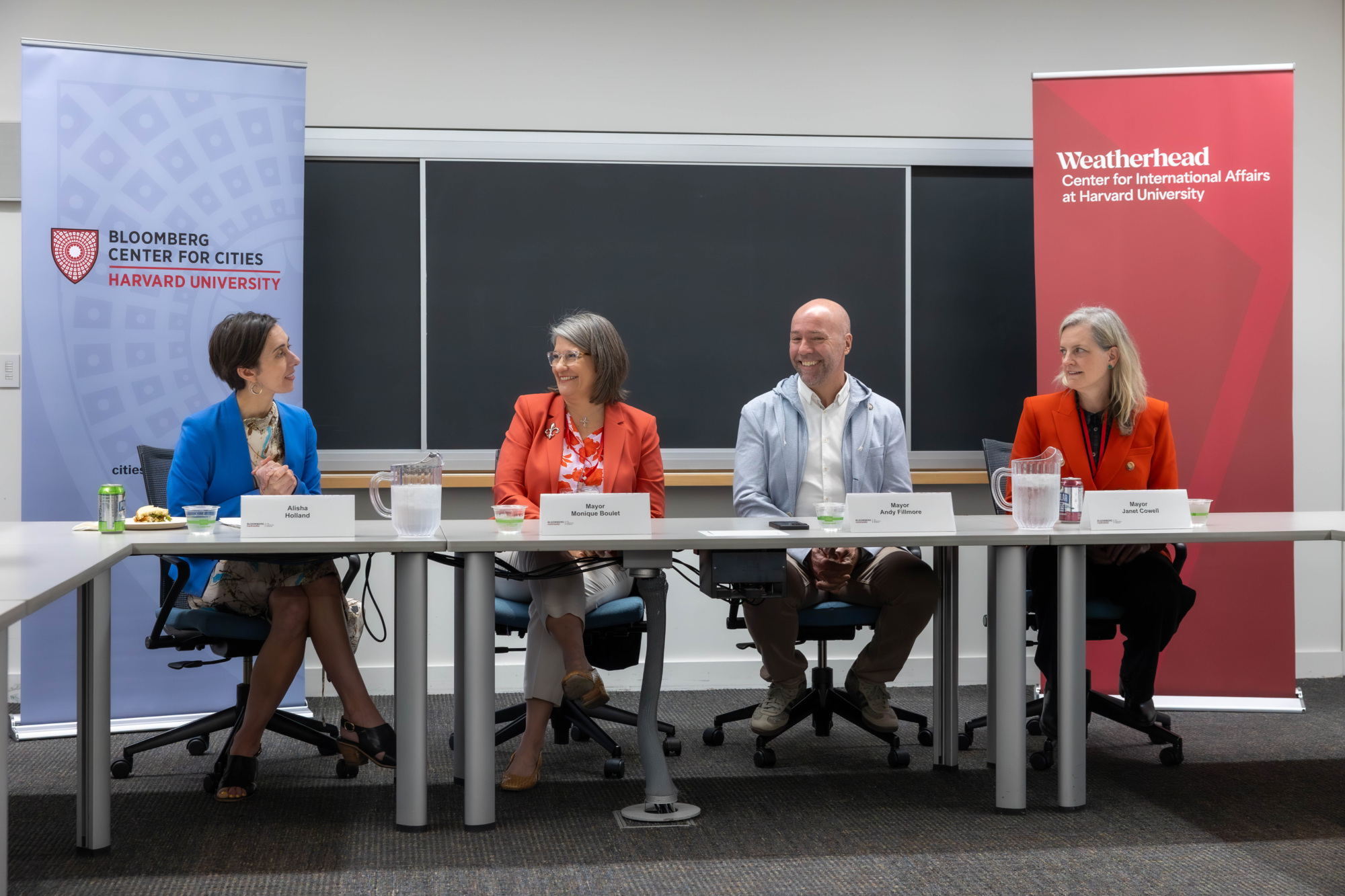
Gathering at the Weatherhead Center for International Affairs as part of the first Global Mayors at Harvard Day, three mayors compared notes on the power of the private sector to help cities build needed infrastructure—and the challenges these projects present.
CAMBRIDGE, Mass. — Cities around the world face pressing infrastructure needs. But building infrastructure raises challenges, in terms of regulation, finance, public sector capacity, and the role of private actors in delivering public goods.
A discussion moderated by Alisha Holland, Gates Professor of Developing Societies in Harvard’s Department of Government and a faculty affiliate of the Bloomberg Center for Cities at Harvard University, brought together mayors from Lafayette, Louisiana; Halifax, Nova Scotia; and Raleigh, North Carolina to compare their own approaches, challenges, and lessons learned.
Co-hosted by the Bloomberg Center for Cities and the Weatherhead Research Cluster on Business and Government, the discussion was one of a series of City Hall Dialogues with students and faculty and part of a capstone convening for mayors in the ninth class of the Bloomberg Harvard City Leadership Initiative that brought together leaders from 45 cities across 16 countries on the Harvard campus for the first time. The Initiative, a program of the Bloomberg Center for Cities at Harvard University, provides mayors and senior city officials with research-based insights and tools to solve urban problems and improve outcomes for residents.
The Value of Partnerships
Each mayor pointed to cases where public-private partnerships (PPPs) had helped cities do what government alone might not have done as quickly, or at all:
In Raleigh, Mayor Janet Cowell highlighted Dix Park, a 300-acre former mental health campus the city has been transforming with the help of a conservancy and private philanthropy. “The private money was plugging into an already architected plan,” she said, describing a model in which public goals came first and outside dollars accelerated them. She recalled the friction that can come even when money is available: “I never thought it would be this hard to give $10 million to a city.”
Halifax Mayor Andy Fillmore pointed to the Nova Centre, a $500 million mixed-use downtown project anchored by a convention center. A lesson learned as it evolved, he said, was broader than the individual development project: “private investment follows public investment.” When government shows it is serious about rethinking and redeveloping a site, he said, private partners are more willing to build around it.
In Lafayette, Mayor Monique Boulet described a highly practical infrastructure problem: aging private sewer lines in the urban core were blocking growth. “We can’t use our money on private lines,” she said, summarizing the legal and administrative barrier. But with Mayors Challenge funding from Bloomberg Philanthropies, Lafayette developed a model that combined grant support with new utility policies so developers could help repair those lines instead of funding more expensive standalone infrastructure.
Political and Practical Challenges
The mayors were equally clear that public-private arrangements are rarely simple. Fillmore noted that Nova Scotia’s bad experience with school partnerships in the 1990s left a lasting hangover. “There is this deep-rooted skepticism,” he said, even after the success of the Nova Centre. Yet, he said, “It’s the only way we’re going to be able to build.”
Cowell noted a different constraint: government often lacks the know-how to structure and negotiate complicated deals. “There’s a lack of expertise,” she said, arguing that cities need more capacity if they are going to pursue these arrangements well.
Boulet focused on the tendency of public systems to default to refusal. “Government finds a way to say no,” she said. “Very easily and very quickly.” For her, the challenge was not just attracting private interest, but reworking rules so that partnership became possible.
Risk, Accountability, and Public Benefit
All three mayors underscored that successful partnerships depend on governments being clear about the public purpose they are trying to serve.
For Cowell, that means the private sector should reinforce, not replace, a city’s vision. Her example from Dix Park worked, she suggested, because the plan was already public and civic in character before philanthropic money entered.
Fillmore made a similar point in political terms. He downplayed the question of who gets credit for a successful deal. “I don’t think it matters,” he said, recalling advice from a predecessor: “It’s amazing what you can get done when you don’t care about who gets the credit.”
Boulet put the matter even more plainly: “There has to be the benefit for whoever’s coming to the table.” But she also stressed that public leaders have to make sure those benefits are aligned with community need. “When it works, it really can make a difference,” she said.
Finding Room to Maneuver
The conversation closed with a sense that cities still need more tools, not fewer. Cowell pointed to airports as one area where public-private partnerships are underexplored in the United States, despite the scale and complexity of airport investment. Fillmore offered that cities should look more often and more seriously at PPPs, especially when traditional funding sources are shrinking. Boulet tied the issue back to everyday development, affordable housing, and basic urban infrastructure: “it is tricky, it’s not simple, but it’s absolutely necessary.”
Across different local contexts, the mayors returned to the same underlying point: partnerships can help cities build, but only when public leaders have the clarity, leverage, and expertise to shape deals to benefit their communities.
Resource: Global Mayors at Harvard Day
Read recaps of three other City Hall Dialogues featuring Harvard faculty in conversation with mayors from across the U.S. and around the world. These events, held across campus on April 14, offered a unique opportunity to explore how innovation in cities is shaping the future of governance.Weatherhead Center Research Cluster on Business and Government
Explore this research group’s work on broad problems of business influence, deglobalization, deindustrialization, concentration, regulation, and technology.Video: Building the City: Mayors on Public-Private Partnerships and Infrastructure
The recorded presentation with Alisha Holland and the mayors of Lafayette, Halifax, and Raleigh will be available soon on our YouTube channel.