
Connecting Schools, Services, and Opportunity for Young People: A Conversation with Mayors
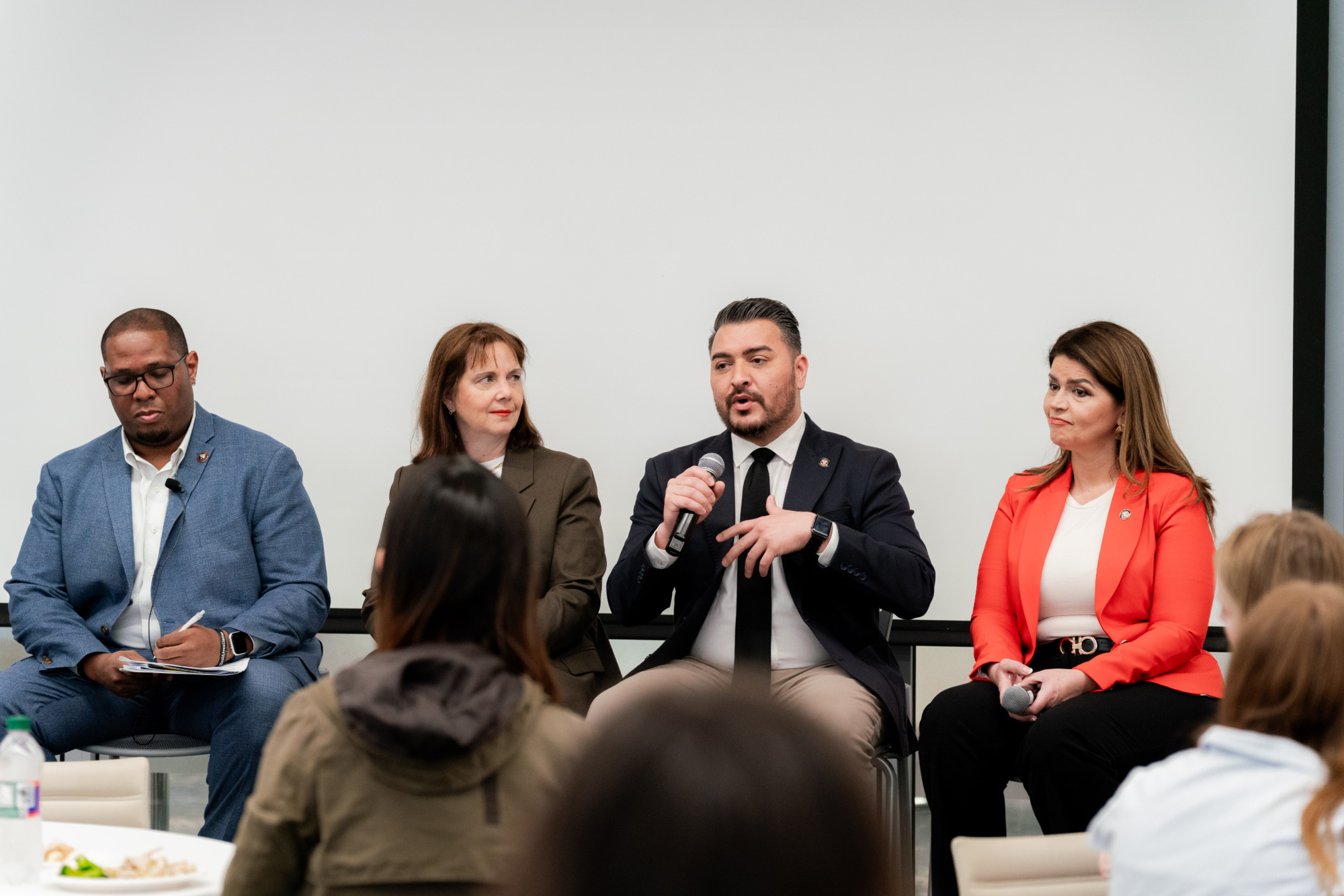
At Harvard Graduate School of Education, as part of the first-ever Global Mayors at Harvard Day, three mayors reflected on how cities and regions can help children thrive by aligning schools with the wider systems that shape opportunity.
CAMBRIDGE, Mass. — Children spend only 20 percent of their waking hours in schools and 80 percent outside them, according to Rob Watson, Jr., Lecturer on Education at Harvard Graduate School of Education (HGSE), Executive Director of The EdRedesign Lab, and faculty affiliate of the Bloomberg Center for Cities at Harvard. This fact established the context for a lively discussion on April 14 with three mayors focused on building integrated community supports and creating better outcomes for children and young adults in their cities.
Co-hosted by the Bloomberg Center for Cities and EdRedesign, the event was opened by HGSE’s Paul Reville, Francis Keppel Professor of Practice of Educational Policy and Administration, EdRedesign Founder and Faculty Director, and another Bloomberg Center for Cities faculty affiliate.
The discussion was one of a series of City Hall Dialogues with students and faculty and part of the capstone convening for mayors in the ninth class of the Bloomberg Harvard City Leadership Initiative that brought together leaders from 45 cities across 16 countries on the Harvard campus for the first time. The Initiative, a program of the Bloomberg Center for Cities at Harvard University, provides mayors and senior city officials with research-based insights and tools to solve urban problems and improve outcomes for residents.
Helping Children Fulfill Their Potential
At the lunchtime discussion, the mayors of Tracy, California; Tucson, Arizona; and the East Midlands in the United Kingdom approached the topic of city-wide partnerships serving children and youth from their different governance structures, each asserting that children’s outcomes are inseparable from the broader conditions of place.
For Dan Arriola, mayor of Tracy, the work is personal. “There was never someone fighting for people like me and my family,” he said, describing why he has made youth investment central to city government. His cradle-to-career strategy includes early childhood investment, stronger ties to students during the K-12 years, and clearer pathways into jobs through internships, public service, and apprenticeships.
For Regina Romero, mayor of Tucson, access to opportunity is the governing frame. “Talent is universal. Opportunity is not,” she said, explaining why Tucson is investing in neighborhoods that have long been under-resourced. City projects include after-school programming, youth employment, and work on neighborhood infrastructure such as parks, sidewalks, trees, and safe routes to school.
Claire Ward, mayor of East Midlands, framed the challenge at a regional scale. “Economic growth in itself is not good enough,” she said. “It has to be inclusive growth.” In a region shaped by deindustrialization and uneven access to jobs, transport, and training, she said, young people need to see clearer pathways into opportunity much earlier in their lives.
Working Without Formal Authority
Mayors described how they can lead even when they do not directly control schools or youth systems. Arriola made those limits explicit: many critical services in California are delivered by counties, not cities, and school districts are separate institutions. But mayors, he said, can still provide space, visibility, and access—by hosting services in city buildings, sharing information through city channels, and using the mayor’s office to convene cross-sector actors, including schools, hospitals, employers, and youth themselves.
Romero made a similar point about her work in Tucson, where the city does not govern the school district but does shape the environment around children’s lives. “The infrastructure that kids are surrounded with matters,” she said, linking neighborhood conditions to health and opportunity. She also described a city pilot in high-violence areas that brought together residents, businesses, parks staff, and other departments and helped produce a significant reduction in gun violence in those areas.
Ward emphasized data and convening power. “It’s too late to wait for [young people] when they become 19,” she said, explaining why her team is trying to identify risk factors much earlier and connect schools, employers, and families before young people disengage. One statistic she cited captured the urgency: “If you have four or more interactions with employers… you are 86% less likely to become a NEET [someone ‘Not in Education, Employment, or Training.’]”
Real-World Levers
The panel’s strongest lesson may have been that mayors do not need full institutional control to find levers to make systems work better together. They can convene, align, pilot, and direct investment. They can use data to identify where need is highest while listening to residents and young people to understand what numbers alone miss.
That came through especially in how the mayors talked about participation. Arriola said adults too often “tell young people what they need without ever asking them what they need.” Romero emphasized providing language translation and childcare, initiating mobile engagement, and showing up where families already are. Ward described giving communities resources and asking them to shape their own priorities.
Audience questions enlarged the conversation to include a discussion of mental health, hard-to-reach families, and alternative pathways beyond college. By the end, an overarching point was clear: helping children thrive is not only the work of schools. It is the work of cities and leaders willing to connect services, opportunity, and belonging around the lives young people are already living.
Resource: Global Mayors at Harvard Day
Read recaps of three other City Hall Dialogues featuring Harvard faculty in conversation with mayors from across the U.S. and around the world. These events, held across campus on April 14, offered a unique opportunity to explore how innovation in cities is shaping the future of governance.More about The EdRedesign Lab
Visit the webpage to learn more about this group’s work.Video: The Role of Mayors in Advancing City-wide Partnerships for Children and Youth: A Conversation with Mayors
The recorded presentation with Rob Watson and the mayors of East Midlands, Tracy, and Tucson will be available soon on our YouTube channel.