
What Global Challenges Look Like in City Halls
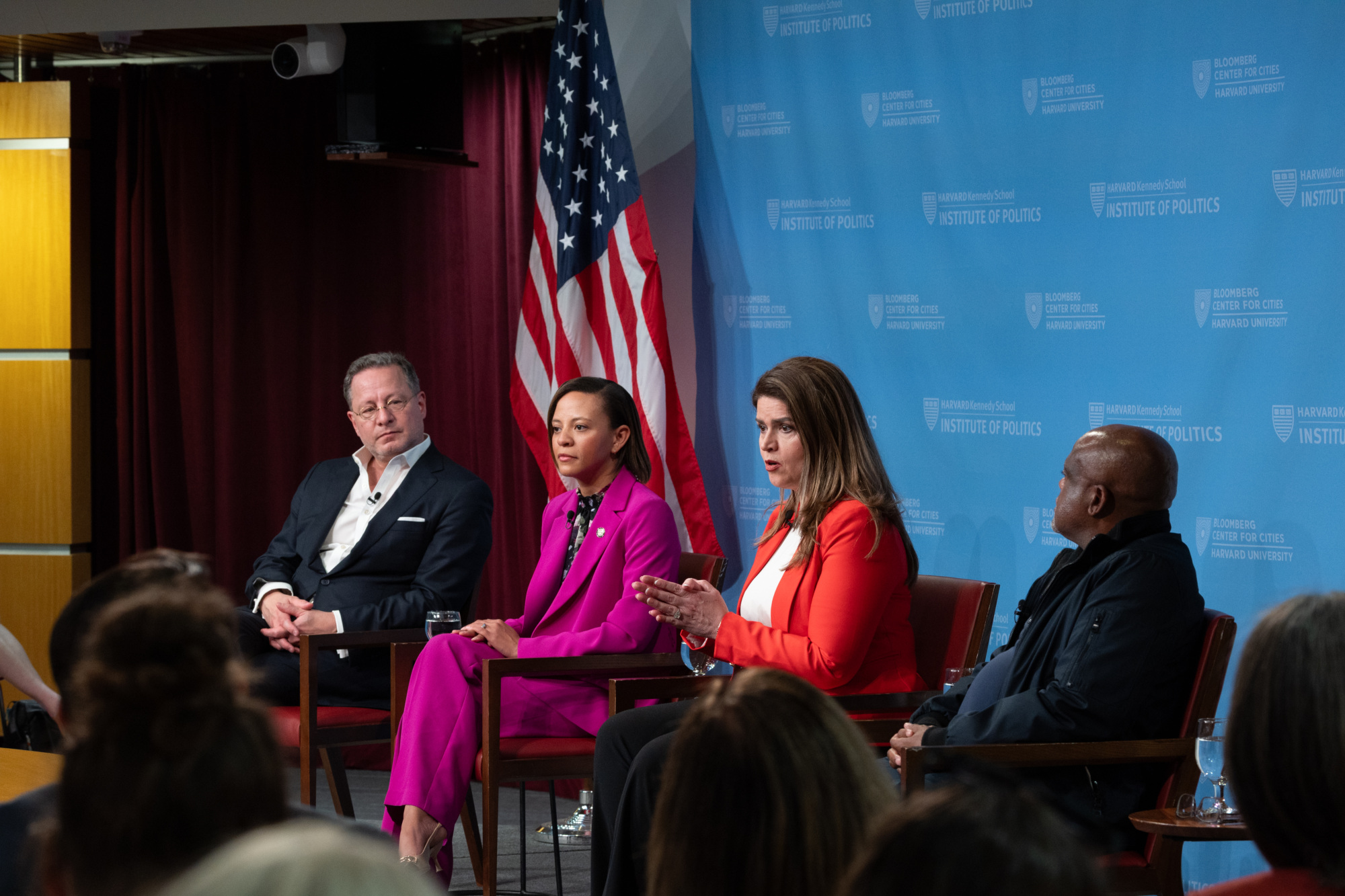
At a Bloomberg Center for Cities event co-sponsored by the Institute of Politics at Harvard Kennedy School, the mayors of Alexandria, Virginia; Johannesburg, South Africa; and Tucson, Arizona, reflected on how climate change, migration, and inequality are testing their city leadership.
CAMBRIDGE, Mass. — In the JFK Jr. Forum on April 14, three mayors described what it means to govern locally in a moment shaped by global pressures. Moderator Rawi Abdelal, Herbert F. Johnson Professor of International Management at Harvard Business School, Emma Bloomberg Co-Chair of the Bloomberg Harvard City Leadership Initiative, and Bloomberg Center for Cities faculty affiliate, said national politics may be faltering, but cities are working well with one another, and local governance is not broken.
From flooding in Alexandria, Virginia, to extreme heat in Tucson, Arizona, to climate adaptation and migration pressures in Johannesburg, South Africa, the discussion returned to a common leadership challenge: mayors may not control the forces reshaping their communities, but they are responsible for responding to the consequences. Below are lightly edited excerpts.
Climate Events as Local Governing Challenges
Abdelal cited extreme weather events as an example of global conditions that affect residents and leadership at the local level. “The nations aren’t fixing this,” he said. “The global system isn’t fixing this, but you are living it.” The panel agreed. Alexandria Mayor Alyia Gaskins described a city with a long history of flooding, now intensified by climate change and aging infrastructure. “We have pipes that are so old they are nearly double or triple my age, and they have not been invested in,” she said. “The biggest issue we face is climate change, because now we are dealing with these incidents more frequently.”
For Tucson Mayor Regina Romero, the defining threat is extreme heat. “Heat is the silent killer,” she said. “Heat kills more people every year than hurricanes and floods combined.” She added, “I knew that climate change is such a crisis that mayors should, and must, work against climate change.”
Johannesburg Mayor Dada Sello Morero described his city’s struggles with both flooding and heat, outlining a split between neighborhoods of mostly affluent, white residents and townships of Black, mostly working-class and poor residents who suffer more from the impacts of extreme weather. In the townships there are no trees, he noted. To tackle the problem where it affects residents the most, the city is increasing the tree canopy, including a campaign that planted 30,000 trees in affected neighborhoods in one month alone. More broadly, the city is also pursuing partnerships and transit investments in a new fleet of e-buses. “Climate change is real, and all of us need to work together towards responding to it,” he said.
Bearing the Burden of Global Change
The mayors emphasized that these effects are not evenly shared. Romero said Tucson used data to analyze who was first and worst impacted by climate extremes, naming “children, seniors, low-income communities, communities of color, and unsheltered homeless people.”
Gaskins said, “We can’t just talk about climate in a vacuum.” In Alexandria, climate concerns emerged through a broader community health assessment. “If we want to achieve greater life expectancy, if we truly believe people can have longer and healthier, better lives, then part of our health strategy must also be a climate strategy,” she said.
Morero discussed a deep divide present in Johannesburg. “It is mostly the working class and the poor that are affected,” he said. In some neighborhoods, he said, “there are no trees. It is hotter than in the suburbs. You can actually feel the difference.”
On Migration, Belonging, and the Work of Planning
Morero explained how the scale and speed of Johannesburg’s growth exacerbate the city’s challenges. “Growth is faster than what we can plan for,” he said, describing a city growing by roughly 10,000 people each month. “It impacts quite negatively on our planning as a city.”
In Alexandria, Gaskins spoke about what it means for global events to register quickly in local institutions. When the United States withdrew from Afghanistan, she said, “within days we had over 200 young people walking into our schools who had never been to our country, did not speak our language.” She pointed to the city’s International Academy as a place where students can feel “safe and comfortable expressing your culture, sharing it with the city of Alexandria.”
Romero, whose city of Tucson, Arizona, sits 60 miles from the Mexican border, described Tucson as “not a receiving city” but “more of a transitional city,” where local government and nonprofit partners provide temporary shelter and connections for people moving onward. “As a daughter of immigrants, Mexican immigrants, I take very seriously the migration needs,” she said. “The data shows us that immigrants contribute greatly to this country.”
Moments that Shape Leadership
Asked about events that changed them as leaders, all three mayors recalled moments of advocacy for their most vulnerable residents. Morero recalled meeting an elderly woman who had been on a housing waiting list since 1994 and was still living in a shack. “All she was asking for was to have her own house before she leaves this world,” he said. The city ultimately moved her higher on the list and “they were able to give her a house this year in January.” He continued, “Those things touch you as a person and as a mayor. At the policy level you make policies, you make decisions, but people are still living in difficulties and you need to respond to their situation.”
Gaskins described visiting an apartment building after tenants raised concerns about mold. Her infant daughter immediately began coughing inside one of the units. She recalled telling the property manager, “I don’t know what is going on in here, but I can tell you there is a problem in this room.” When he said she lacked the authority, her response was immediate: “Just watch me.”
Romero linked public service to her own childhood in a trailer park in Arizona with immigrant parents, in a neighborhood overlooked by public investment. “That has driven me throughout my service for my community,” she said. “I will always fight for equity and justice and a good quality of life for every single child and family in Tucson no matter their ZIP code and where they live.”
Audience questions included how peer learning occurs among mayors and the personal encounters with residents that have shaped the mayors’ leadership. Taken together, the three mayors painted a picture of city leaders on the front lines, meeting global problems first and most directly in people’s daily lives.
Resource: Global Mayors at Harvard Day
Read recaps of three other City Hall Dialogues featuring Harvard faculty in conversation with mayors from across the US and around the world. These events, held across campus on April 14, offered a unique opportunity to explore how innovation in cities is shaping the future of governance.Video: Global Challenges, Local Leadership: How Mayors Deliver Results
Watch the recorded discussion with Rawi Abdelal and the mayors of Alexandria, Johannesburg, and Tucson.